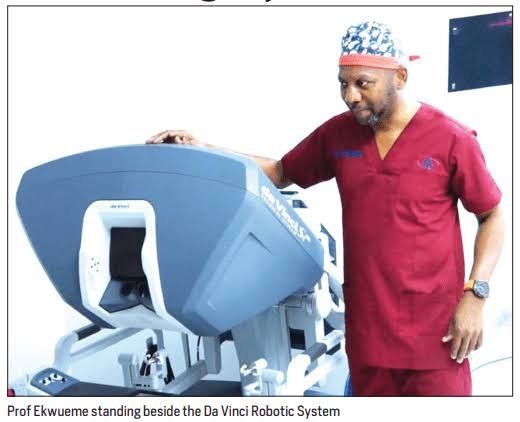
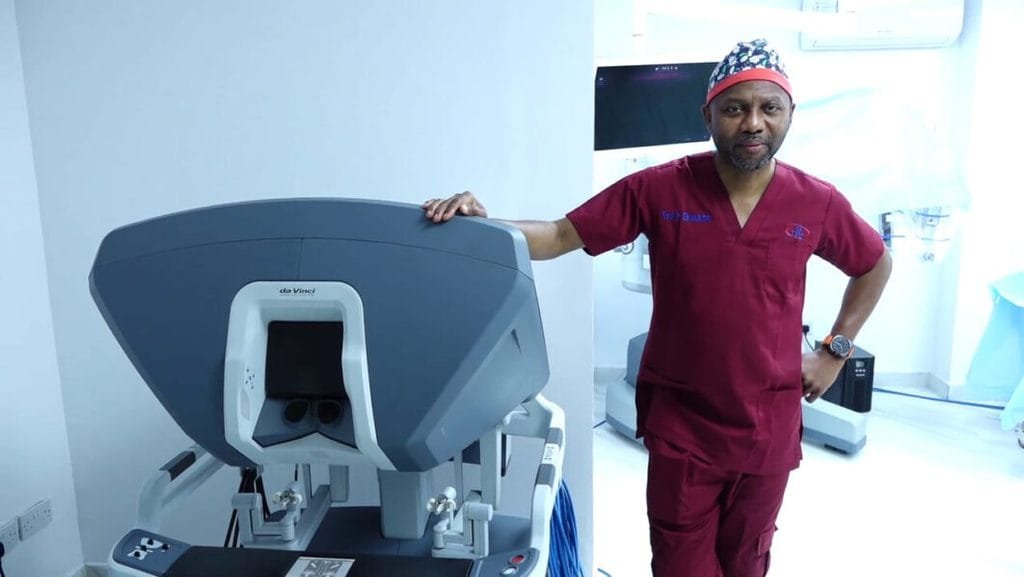
Surgeons at Redeemer’s Health Village in Ogun State have confirmed what many patients and families in Nigeria have long hoped to hear: robotic-assisted surgery can significantly reduce postoperative pain and shorten hospital stays.
The declaration followed the successful completion of the hospital’s first robotic procedure—a radical prostatectomy performed on a middle-aged man with localised prostate cancer.
The operation, carried out in partnership with the US-based RoboMed Global Inc., marks a practical step toward making advanced, minimally invasive surgery available within Nigeria rather than requiring patients to travel abroad.
The key advantages stem from the nature of the technology itself. Instead of large open incisions, robotic systems allow surgeons to operate through several small ports. These smaller cuts cause less trauma to surrounding tissues, resulting in reduced blood loss, lower risk of wound infection, and markedly less postoperative pain.
Patients can often leave the hospital the next day or even the same day in suitable cases rather than remaining for several days or longer after conventional open surgery.
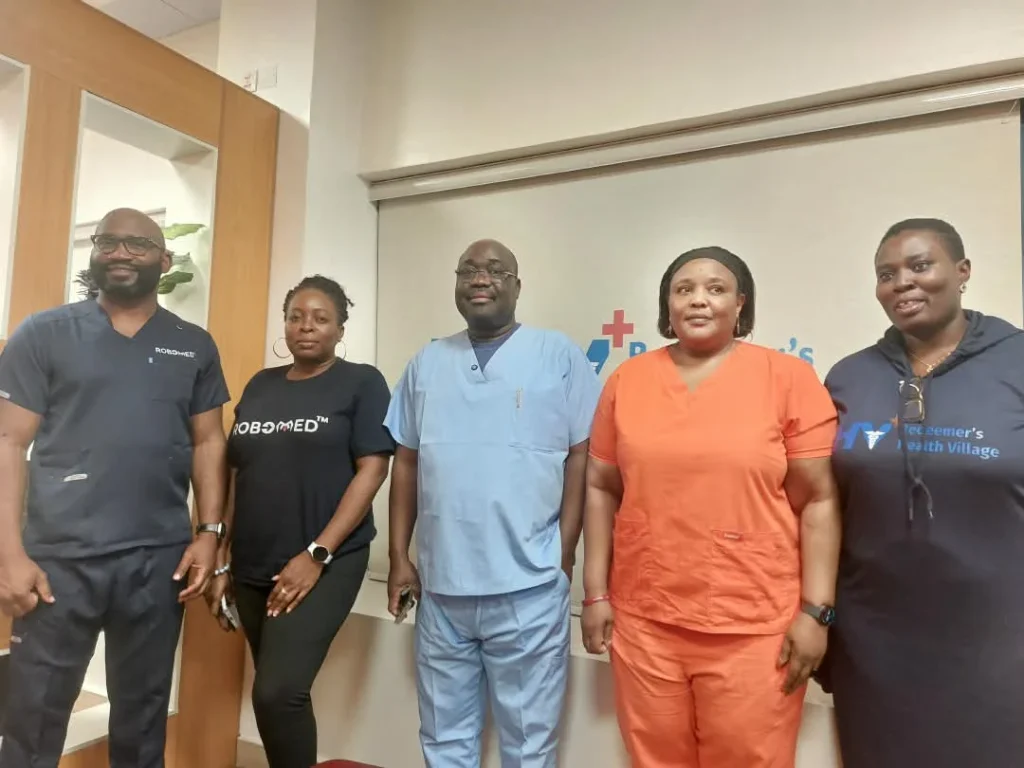
The Chief Executive Officer of RoboMed Global, Prof. Obi Davies-Ekwenna, the Chief Executive Officer of Redeemer’s Health Village, Dr. Ademola Dada, and other members of the team. Photo Credit: Punchng.com
Prof. Obi Davies-Ekwenna, Chief Executive Officer of RoboMed Global and the lead robotic surgeon says “The surgeon remains fully in control from a console, directing the robotic arms in real time meaning, the combination of magnified high-definition visualisation and tremor-filtered instrument control gives surgeons greater precision than the human hand alone can ever achieve”.
Dr. Adedamola Dada, Chief Executive Officer of Redeemer’s Health Village, emphasised that the goal extends beyond a single successful case. The faith-based 300-bed multispecialty hospital, established by the Redeemed Christian Church of God and located in Redemption City, Mowe, Ogun State, invested approximately $4 million to introduce the robotic programme. The investment covers both the technology and a structured training pathway designed to build local expertise.
Future Plans include a robotic surgery academy with a five-stage curriculum that covers didactic lectures, dry-lab simulation, wet-lab training on cadaver and animal models, supervised human cases, and formal credentialing so that Nigerian surgeons can perform and support these procedures independently over time.
The first case was deliberately chosen for its clinical suitability. Localised prostate cancer that has not spread beyond the gland is particularly well-suited to robotic-assisted radical prostatectomy.
The Robotic technology enables precise removal of the prostate while helping preserve nearby nerves and structures important for continence and sexual function. Similar benefits are expected for other urological procedures, as well as selected gynaecological, general surgical, and colorectal operations. The Hospital leadership indicated that additional robotic cases covering prostate, kidney, uterine, and colonic conditions were scheduled in the days following the inaugural procedure.
Beyond clinical outcomes, the programme addresses a longstanding economic and social burden: medical tourism. Thousands of Nigerians travel each year to India, the United Arab Emirates, Europe, or the United States for complex surgical care. The costs are high, the logistical challenges substantial, and the foreign-exchange outflow significant. Redeemer’s Health Village aims to offer comparable procedures at roughly five percent of the price charged in the United States or Europe. A prostate cancer operation that might cost ₦29–30 million elsewhere in Nigeria or far more abroad is being priced closer to ₦20 million at the facility—still substantial for many families, yet a meaningful reduction that could bring advanced care within reach of a larger segment of the middle class and insured patients.
The broader context is equally important. Nigeria’s healthcare system has struggled for decades with shortages of specialist capacity, ageing infrastructure, and uneven distribution of advanced services. Most high-end surgical technology has historically been concentrated in a few private centres in Lagos or Abuja. Locating a robotic programme in Ogun State, within the Redemption City ecosystem, expands geographic access and signals that specialised care need not remain confined to the largest commercial cities.
Government officials have publicly welcomed the development. The Minister of State for Health and Social Welfare noted that robotic-assisted surgery offers greater precision, faster recovery, and shorter hospital stays, describing the initiative as a contribution to reducing medical tourism and strengthening specialist capacity within the country.
It is important to maintain realistic expectations. Robotic surgery is not inherently superior for every patient or every condition. Suitability depends on the specific diagnosis, the patient’s overall health, the surgeon’s experience, and the availability of a well-trained supporting team.
Open or conventional laparoscopic approaches remain appropriate and sometimes preferable in certain situations. The technology also requires reliable electricity, robust maintenance, and ongoing training—factors that have challenged technology adoption in many Nigerian hospitals.
Redeemer’s Health Village and its partners appear conscious of these requirements; the accompanying training academy and collaboration with institutions such as Redeemer’s University and the National Postgraduate Medical College are intended to create a sustainable pipeline of skilled personnel rather than a one-off demonstration.
Patient experience is where the benefits become most tangible. Smaller incisions translate into less tissue disruption, which in turn means lower levels of pain medication, earlier mobilisation, and a quicker return to normal activities. Reduced infection risk is especially relevant in settings where hospital-acquired infections remain a concern.
For working-age patients such as teachers, traders, professionals, and civil servants, the ability to leave hospital within 24 hours and resume productive life sooner carries both personal and economic value. Families spare the emotional and financial strain of prolonged hospitalisation or overseas travel. The psychological reassurance of receiving world-class care close to home should not be underestimated.
The partnership model itself is noteworthy. RoboMed Global brings specialised robotic expertise and systems knowledge; Redeemer’s Health Village contributes a functioning multispecialty hospital environment, local clinical teams, and a commitment to training. Early indications suggest the collaboration will extend beyond on-site cases.
In the days after the first prostatectomy, the same network achieved West Africa’s first tele-robotic surgery—a right radical nephrectomy performed remotely from a console at Redeemer’s Health Village on a patient at Nisa Premier Hospital in Abuja. The successful linkage of two Nigerian institutions across distance demonstrates a possible pathway for specialist expertise to reach patients who cannot travel, provided connectivity and safety protocols remain robust.
Looking ahead, the sustainability of the programme will depend on several factors: continued investment in training, transparent pricing that balances cost recovery with accessibility, reliable supply chains for consumables, and careful outcome tracking so that results can be measured against international benchmarks. Public and private insurers will need to develop coverage policies that recognise the value of shorter stays and reduced complications. Regulatory oversight must ensure that only properly credentialed teams perform these procedures. If these elements align, robotic surgery could gradually move from a rare, high-profile service to a more routine option for selected conditions across Nigeria and the wider West African region.
For now, the message from the surgeons at Redeemer’s Health Village is clear and grounded in the first clinical results. Robotic-assisted surgery, when appropriately applied, reduces the physical trauma of major operations. Patients experience less pain. They leave hospital sooner. The risk of certain complications declines. And for the first time in a meaningful way, some of the most advanced surgical techniques available globally are being delivered inside Nigeria by teams that include Nigerian professionals, at a fraction of the overseas cost.
That combination of clinical benefit and geographic accessibility represents genuine progress in a healthcare landscape that has too often forced patients to choose between substandard local options and prohibitively expensive foreign care.
The technology will not solve every surgical challenge, nor will it instantly transform the entire system. Yet the successful first cases at Redeemer’s Health Village demonstrate that the tools of modern minimally invasive surgery can be brought home. For patients facing prostate cancer, kidney tumours, or other conditions amenable to robotic approaches, the prospect of smaller scars, less pain, and a quicker return to family and work is no longer an overseas dream. It is becoming a local reality.
By