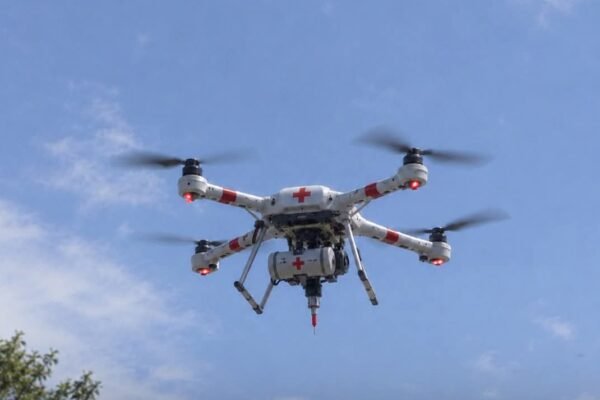

Aspen Fire Protection District firefighters and personnel are currently testing an advanced fleet of artificial intelligence-equipped drones designed to suppress fires in high-rise buildings and other high-risk environments. These systems represent a notable step forward in aerial firefighting technology.
The drones themselves have a distinctive appearance, resembling large insects. Finished in black and white, each unit features propellers mounted on four substantial arms and measures roughly 10 by 12 feet comparable in footprint to a compact moving trailer.
Although drones have long supported wildfire monitoring, this new platform goes further by incorporating AI to assist actively in fire suppression.
California-based company Seneca developed the system, which is engineered to operate in coordinated groups. A swarm of five drones can transport between 500 and 1,000 gallons of finished firefighting foam, functioning in a manner similar to a small ground-based engine.
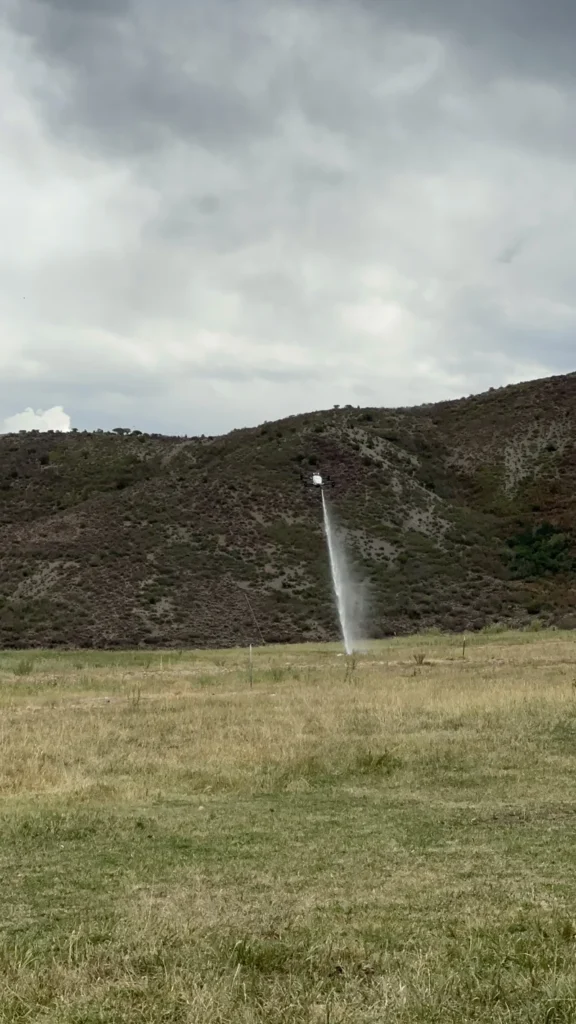
Personnel in Aspen have found the aircraft straightforward to control as Deputy Chief Andy Fisher remarked that the controls are simple enough that even a young teenager could manage them.
Once Aspen Fire formally activates its drone program potentially as early as next year, it is expected to become the first fire department worldwide to run these systems independently.
Until now, the drones have been deployed only on prescribed burns in California, always with on-site support from Seneca technicians.
Fisher envisions deploying the aircraft to inaccessible incidents, such as remote lightning-caused starts, ahead of ground crews.
This comes as Aspen sits amid dense forest surrounding high-value real estate and offers limited evacuation routes, creating elevated risk for both residents and visitors.
”If we could get it quick, keep them small and attack them while they’re smoldering instead of waiting for the wind to pick them up, I feel like that’s the most ideal use case,” Fisher said.
According to Seneca’s founder Stuart Landesberg, the drones can bypass steep or otherwise treacherous terrain quickly and have a range of 5 to ten miles plus they can hit double that if they’re empty.
Hovering over a fire, they use an AI-supported “sensor suite,” that can calculate distance and wind speed, then release water or retardant at a specific angle and velocity to tamp down flames.
Rapid intervention while fires remain small and smoldering, rather than waiting for wind-driven growth, is viewed as an especially promising application.
Landesberg said the drones won’t replace air tankers on big fires, but they can carry tools, monitor ongoing fires and help extinguish lingering hot spots. Compared to helicopters, they could also make aerial firefighting more affordable.
”We can be the next best thing at two orders of magnitude less cost,” he said.
Relative to traditional helicopters, the drones also offer a more cost-effective aerial option of delivering comparable utility at a fraction of the expense.
Aspen Fire anticipates investing approximately $2.5 million over five years, with private donors covering the cost.
Fire agencies elsewhere are monitoring the Aspen pilot closely to gauge real-world performance before considering similar investments in this emerging technology.