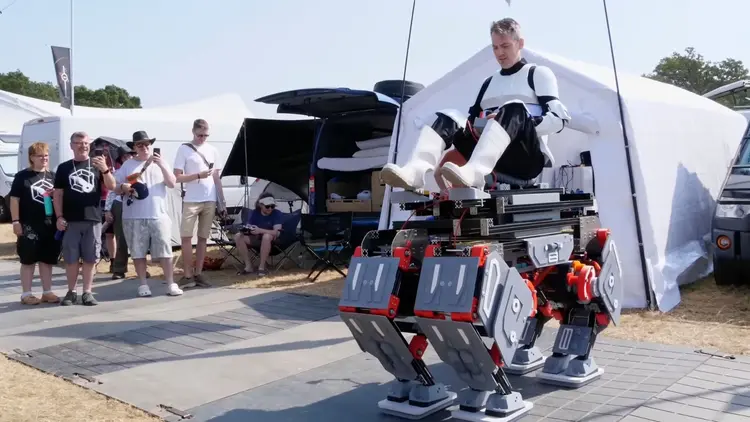
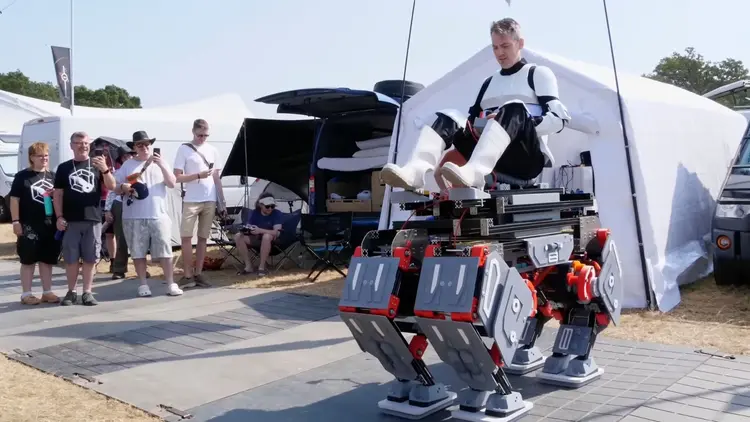
UK YouTuber and Engineer James Bruton has built a Large Custom Quadruped walking Machine designed so he can ride it, with ongoing development aimed at practical mobility including steps, turning, and eventually adapting to more varied terrain.
James Bruton who owns the Popular YouTube channel XRobots / James Bruton, with around 1.4 million Subscribers, is a well-known UK-based Innovator Specializing in experimental robotics, 3D-printed mechanisms, unusual vehicles, and large-scale walkers.
He has previously built Rideable Machines such as a functional Star Wars AT-AT-scale Quadruped walker that he has ridden, along with other personal transport experiments (omni-wheel bikes, ball-wheeled vehicles, transformers, etc.). In 2025–2026 he launched a dedicated ongoing project for a smaller, faster, more practical quadrupedal walking machine explicitly intended for him to ride.
Project Overview and Design Philosophy
The machine is a true Quadruped with four independent Legs that can change height, combined with sliding sections that allow it to take steps by shifting body mass relative to the grounded feet. It is deliberately not a Strandbeest-style linkage walker.
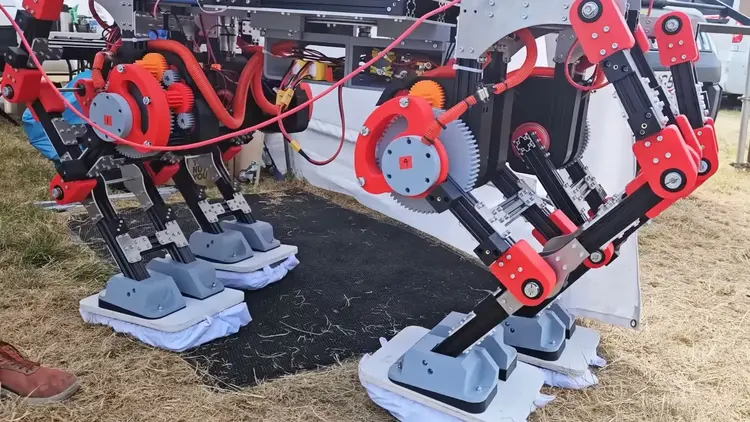
Key Mechanical Features include:
- High-reduction custom gearboxes including Planetary-style multi-stage reductions in the thousands-to-one range, compared against cycloidal drives which are driven by Powerful motors for torque.
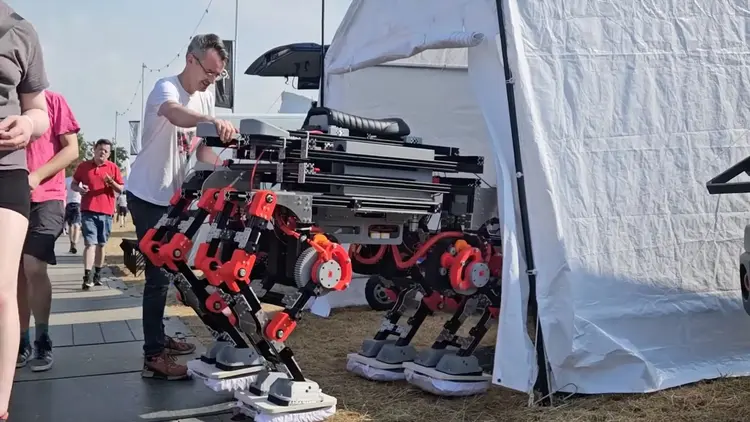
- Sliding Mechanisms initially made using heavy-duty desk-drawer slides rated for Significant loads, overlapping for ~400 mm total travel) so the body can advance while two legs are planted.
- Rotary axes with large Lazy-Susan Bearings and geared racks so the Machine can turn in place by lifting pairs of legs.
- Structural elements of aluminium extrusion (4040 profiles), large 3D-printed parts (often with 1.2 mm nozzles on long-bed LulzBot printers for speed and strength), and bearings.
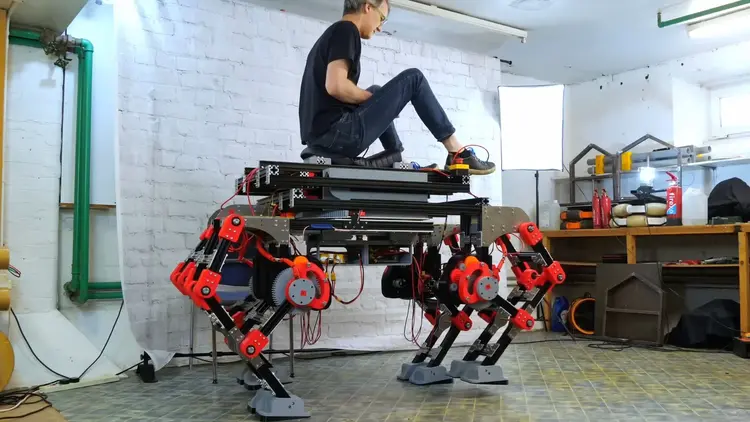
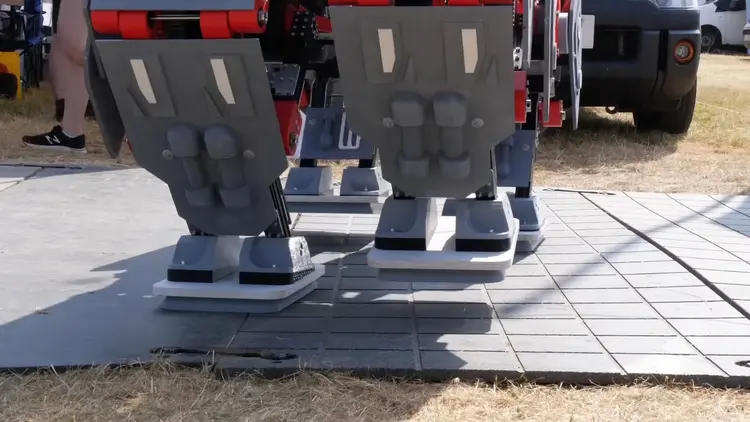
- Plans for compliant feet and additional sliding sections to keep the rider’s mass properly positioned over the grounded feet.
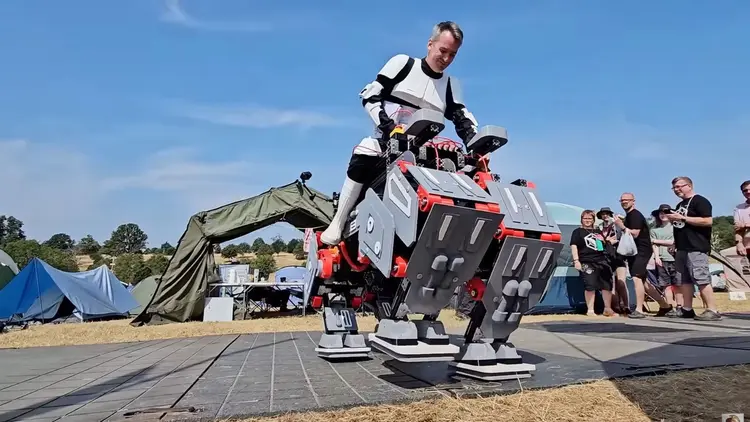
Bruton has tested the Structure supporting his own weight on two legs, assembled the full mechanism, and demonstrated basic walking and turning including outdoor testing at events such as EMF Camp to explore stability on uneven ground.
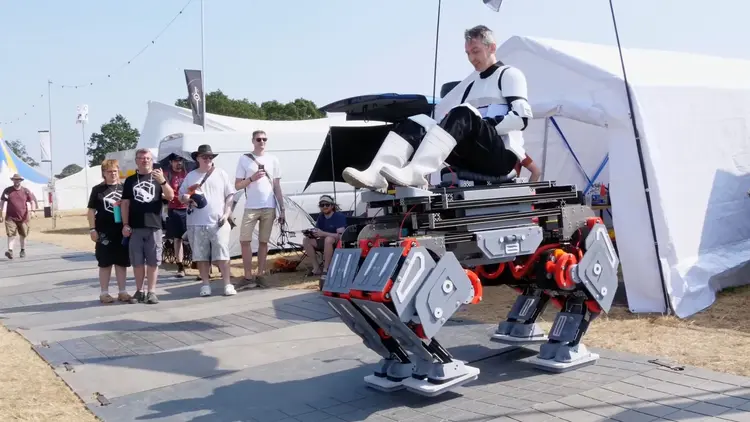
One approach experimented with 20-sided dice as temporary foot stabilizers while refining control. He has positioned himself on the Machine during tests, confirming it can hold a human rider, though a proper seat and full control refinements are still in progress.
Top speeds in early tests are modest (references around 8 km/h appear in related discussion), with the explicit goal of a more transportable, faster platform than his earlier AT-AT-scale build.
Parts of the project (referred to in some updates as Mid-Walker) are being released open-source on GitHub, consistent with Bruton’s long-standing practice of sharing designs, CAD, and code so others can learn from or replicate his work.
Progress Toward Riding and Longer Distances
As of mid 2026 the Machine walks, turns, and supports human mass in short tests. Full continuous riding with a dedicated seat, refined inverse-kinematics or trajectory control, better compliance for rough terrain, and endurance (battery life, motor cooling, structural fatigue under sustained load) remain active development areas.
Bruton has repeatedly framed the project as iterative: gearbox development, Mechanism assembly, stability experiments, and outdoor trials. The ambition is a practical rideable Quadruped rather than a pure demonstration piece, something that could cover meaningful distances once the control, power, and compliance systems mature.
This sits in a broader context of Bruton’s career. He previously open-sourced elements of openDog (a Spot-inspired quadruped) and has spent years refining quasi-direct-drive actuators, compliance via current control or simulated springs, and large-scale 3D-printed structures. His rideable AT-AT proved the concept of a human-carrying walker at low speed; the new machine aims for better speed, transportability, and terrain capability.
Mobility and Terrain Issues
Building a human-scale rideable quadruped that is both stable and efficient over long distances is non-trivial. Bruton’s present Issues include:
- Dynamic balance when only two legs are grounded and a human’s shifting center of mass is present.
- Power density and thermal management for sustained walking under load.
- Foot design and compliance for real terrain (flat workshop floors are far easier than trails or slopes).
- Structural stiffness versus weight.
- Control complexity for smooth gaits, turning, and obstacle negotiation.
Commercial platforms (Unitree, Boston Dynamics, research machines such as ETH Zurich’s Barry) have demonstrated human payloads or short rides, multi-kilometer ranges with moderate loads, and rough-terrain capability, but they are typically not sold or designed as everyday personal transport.
Bruton’s approach is pure maker engineering: rapid iteration with accessible tools including: 3D printing, off-the-shelf bearings and extrusions, open controllers, public documentation, and a clear personal goal of riding the machine himself.
Bruton’s work demystifies large-scale legged robotics. By showing the full process gearbox prototyping, Structural Testing under his own weight, outdoor trials, failures and fixes, he makes the Engineering transparent.
A successful rideable version capable of longer Distances would be a striking demonstration which indicates that determined individual Makers can push Human-carrying quadrupeds beyond Laboratory or industrial Prototypes into personal experimental vehicles.
The project is still evolving. Latest videos on Bruton’s YouTube Channel show the machine walking with a human aboard in test configurations and refining stability for uneven ground.
https://youtube.com/watch?v=5YPduEo7dU4&si=S8p81Fd2Koz4niN-
James Bruton is actively constructing and iteratively improving a Custom Quadruped expressly so a Human can ride it. While full Long-distance capability is a work in progress rather than a finished claim, the Mechanical foundation, Load-bearing tests, and open development process make it one of the more transparent and ambitious personal Rideable Quadruped projects currently underway.
SUBSCRIBE TO SEEDUFY TECH NEWSLETTER
[sureforms id=’2360′]